Take a scroll through interior design history, from 1940 to 2015.
We may not have cracked the code on time travel just yet, but photographs come remarkably close. With a single snapshot, you can step into another era and see how people once lived, decorated, and gathered at home. If you’ve ever wondered what interiors across the United States truly looked like from the 1940s through 2015, consider this your invitation to take a closer look.
These images capture far more than four walls and a roof—they reveal shifting tastes, cultural influences, and the design trends that defined each decade. From the tidy, pastel kitchens of the postwar years to the bold experimentation of the ’60s and ’70s, every period leaves its mark. Expect to see floral upholstery that made a statement, layers of patterned wallpaper, plush shag carpeting underfoot, mirrored walls, brass fixtures, and plenty of wood paneling along the way.
As styles evolved, so did the layout of the American home, reflecting changes in family life, technology, and entertainment. Whether you’re feeling nostalgic or simply design-curious, these photos offer a fascinating window into the spaces that shaped everyday life for generations.
1940
 Chicago History Museum//Getty Images
The first half of the 1940s were defined by World War II, and because many materials were unavailable during the war, decor stayed relatively static. This 1940 living room has classic ’30s hallmarks, including damask curtains.
1941
 Jim Heimann Collection//Getty Images
Still, evidence of the technological advancements of the 1930s made its way into the residential design world. Here, the curved lines of the furniture have a Streamline Moderne quality about them—the design movement was inspired by aerodynamic design.
1942
 Bettmann//Getty Images
In the early 1940s, radio was still the primary form of living room entertainment. Though televisions had been invented, they were far more expensive than radios, which were found in more than 80 percent of American homes at the time.
1943
 Chicago History Museum//Getty Images
The beginnings of the midcentury modern design movement started to take root in the 1940s—but it didn’t flourish until after the end of World War II.
1944

Art Deco and Art Nouveau were still popular in the first half of the 1940s. The geometry of the wall hanging is very Deco in nature, while the organicism of the headboard is more Nouveau.
1945
 Harold M. Lambert//Getty Images
In the 1940s, kitchens were quite compact. They did, however, benefit from modern appliances.
1946
 Bettmann//Getty Images
Florals were definitely popular in the 1940s, especially in upholstery, though they’d soon make way for more modern design. As with all design trends, however, they come back!
1947
 Bettmann//Getty Images
The ’40s were a transitional period. Here, a TV set makes an appearance in an otherwise pretty traditionally decorated living room.
1948
 H. Armstrong Roberts/ClassicStock//Getty Images
Chinoiserie might have been more of a 19th-century fad, but it made a strong comeback in the 1930s. And its presence continued well into the 1940s, especially as international travel and trade opened up in the postwar years.
1949
 Harold M. Lambert//Getty Images
Patterned wallpaper was quite popular in the 1940s. Instead of a traditional floral motif, this one in a bedroom features a more abstract design.
1950
 George Marks//Getty Images
By 1950, televisions were becoming more popular in American homes. But that didn’t stop people from continuing to decorate with a more rural style—take, for instance, this gingham-upholstered chair.
1951
 American Stock/ClassicStock//Getty Images
The butterfly chair, officially called the Hardoy chair or the BKF chair, was developed in Argentina in the 1938, but it became a huge success in the U.S. in the 1940s after it was produced by Artek-Pascoe and Knoll. But once the design entered the public domain in 1951, its popularity exploded, with some five million copies produced within a decade.
1952
 Harold M. Lambert//Getty Images
Tropical motifs, like this curtain, were all the rage in the 1950s—not only in interior design, but also fashion. The fringed armchair, however, is left over from the 1930s and 1940s.
1953
 Daily Herald Archive//Getty Images
Tiled fireplaces—a revival of an Art Deco stylistic choice—were on-trend in the 1950s. And wallpapers, especially geometric-patterned ones, were also going strong.
1954
 Denver Post//Getty Images
Open floor plans took off in the 1950s and became a signature of midcentury modern homes.
1955
 Hulton Archive//Getty Images
Nothing says “1950s” like a black-and-white, checkered linoleum floor. But here, it’s paired with country details, including Shaker-style chairs and painted porcelain jars.
956
 Keystone Features//Getty Images
Kitchens began to grow in size in the ’50s, in part because of the need for extra space for all the new appliances being developed and added into homes. In this house, there’s a dishwasher and a garbage disposal.
1957
 Hulton Archive//Getty Images
Pastel colors, particularly mint green and baby pink, were two of the most popular colors for interior design. Interestingly, they were often paired with red accents.
1958
 Slim Aarons//Getty Images
Truman Capote had an unabashed flair for maximalism, which was losing out in popularity to minimalism by the late 1950s. Still, Capote’s home has touches of other popular ’50s trends, like Chinoiserie, patterned wallpaper, and a red palette.
1959
 Harold M. Lambert//Getty Images
It’s not always about incorporating all of the latest and greatest trends into your home. This simple living room stuck to the basics when it came to furnishing, though the colors are decidedly 1950s.
1960
 Bettmann//Getty Images
Curved fridges are Smeg’s signature these days—and in 1960, the appliance’s silhouette was found in kitchens across the country. Check out that Formica table too.
1961
 Denver Post//Getty Images
The matching curtains and bench upholstery have a funky pattern that feels very ’60s—but there’s still quite a bit of traditional decor here, like the two oval-framed portraits.
1962
 Denver Post//Getty Images
Slate floors, often with different colored stones, became very popular in midcentury homes. The chair in front of the fireplace is an Eames Molded Plywood Chair, designed in 1946 and named by Time magazine as “The Best Design of the 20th Century.”
1963
 Denver Post//Getty Images
Within open floor plans in midcentury homes, room dividers provide distinction between rooms. This one takes on a Chinese-inspired pattern.
1964
 Slim Aarons//Getty Images
It’s not always about the über modern in the 1960s. Socialite Ann Bonfoey Taylor’s Vail home shows how traditional decor was still en vogue.
1965
 Afro Newspaper/Gado//Getty Images
Lighting design changed greatly in the 1960s, as fixtures became far more sculptural in form.
1966
 Martin Mills//Getty Images
Open floor plan, large kitchen, vaulted ceiling—this house checks all the midcentury modern boxes. (It’s the Los Angeles home of singer Dean Martin.)
1967
 H. Armstrong Roberts/ClassicStock//Getty Images
Now you can see the multicolored slate flooring in its full magnificence! The material was used throughout the house, from the kitchen to the living room to the patio.
1968
 Hulton Archive//Getty Images
This basement showcases some of the bolder design trends of the late ’60s, namely the op art on the wall and the colorful chair. But it also showcases neutral decor, like the wood-paneled walls.
1969
 Mirrorpix//Getty Images
Though most American households wouldn’t have such a complete set of modern furniture, this photo shows some of the more minimalist, yet avant-garde, works of furniture design from the period. Take note of the acrylic chair—you almost can’t see it.
1970
 H. Armstrong Roberts//Getty Images
Monochromatism was a bit of a big deal. Patterns and textures help to break up the overwhelming pinkness of this room.
 Bill Johnson//Getty Images
1971
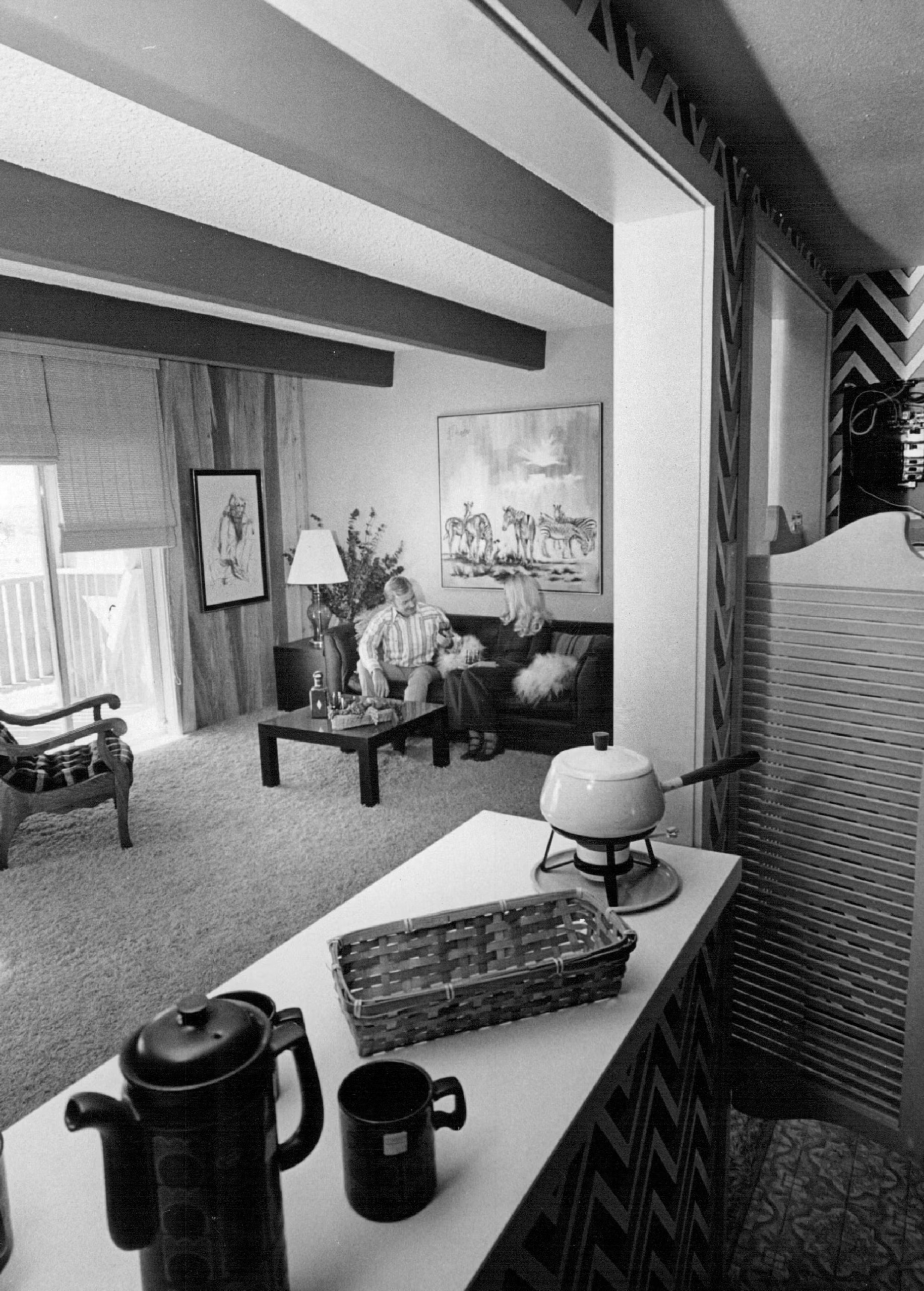
Ah, who could forget about shag carpet? It’s a hallmark of the ’70s.
1972
 ClassicStock//Getty Images
By 1972, glass-topped coffee tables had been around for some two decades, and they’re still used today. Glass tables—or any clear furniture for that matter—provide the illusion of more space.
1973
 Slim Aarons//Getty Images
Philanthropist Mrs. Donald Harrington shows off her traditionally decorated parlor, which seems rather timeless, but the piece of furniture that firmly places these photos in the ’70s? That scalloped ottoman.
1974
 H. Armstrong Roberts/ClassicStock//Getty Images
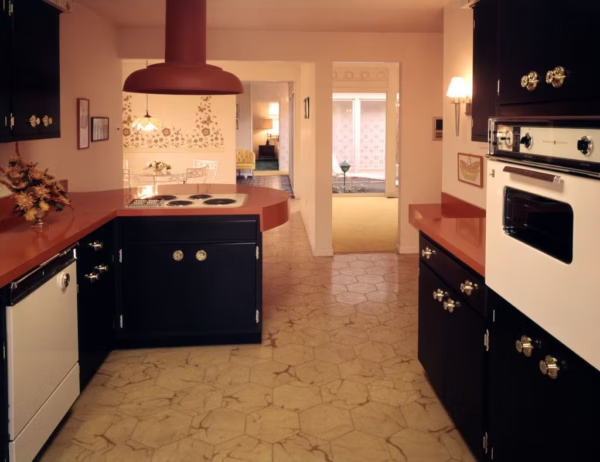
Kitchens are getting more and more modern by the mid-’70s. Black cabinets, white appliances, and red counters are a bold design choice—and one that is perfect for the decade.
1975
 David Hume Kennerly//Getty Images
By 1975, florals are back. So are matchy-matchy sets, like a canopy and a comforter, as shown in Betty Ford’s bedroom.
1976
 H. Armstrong Roberts/ClassicStock//Getty Images
It’s not all about pinks and reds. Teal was another trending color in the ’70s.
1977
 Susan Wood/Getty Images//Getty Images
The blue bookshelves in this library could be very 2020s, but it’s the batik slipcovers on the sofas that date this room. (And the tie of former New York City Deputy Mayor Osborn Elliott, Newsweek magazine editor at the time.)
1978
 Susan Wood/Getty Images//Getty Images
You’d have to be pretty brave to install this kind of kitchen. Yes, red was still very much a thing in 1978.
1979
 Susan Wood/Getty Images//Getty Images
Paisley, pinks, and reds—this is certainly a ’70s bedroom. It belongs to businesswoman Helen Gurley Brown, who was the editor-in-chief of Cosmopolitan (House Beautiful’s sister magazine).
1980
 Michael Ochs Archives//Getty Images
The floral-meets-plaid wallpaper is a pretty retro design choice. Paired with wood cabinets? Well, now, that’s going to take some work to update.
1981
 HUM Images//Getty Images
If you’re curious about the quintessential American home, look no further than the White House. With each new president comes new decor. In 1981, President Ronald Reagan and his wife Nancy epitomized the early ’80s with floral wallpaper, white sofas, and pastel pink carpet in their living room. (See the White House interiors through the years here).
1982
 John Preito//Getty Images
In the early 1980s, open concept floor plans were all the rage. In terms of kitchens, that meant it was time for peninsulas and islands to shine.
1983
 Slim Aarons//Getty Images
Forget the floral sofas of the ’70s. Contemporary couches in the 1980s were low-slung and deep-set—ideal for reclining, as socialite Mollie Wilmot models here.
1984
 Paul Harris//Getty Images
But it wasn’t always about super-modern design. Rusticity still had a place in ’80s homes. Here, Harrison Ford shows off his woodworking talents with a dining set he made himself.
1985
 H. Armstrong Roberts/ClassicStock//Getty Images
While pastels were popular in the ’80s, so were brighter color choices. Many homeowners had no issues combining both.
1986
 United Archives//Getty Images
If you had wealth in the ’80s, you probably weren’t afraid to show it off with opulent decor, like crystal chandeliers and velvet dining chairs.
1987
 Diana Walker//Getty Images
There’s a double dose of nostalgia in the kitchen of Judge Douglas H. Ginsburg. First, check out those laminate countertops, an ’80s staple. Second, look at those colorful fridge magnets—sure to take you right back to childhood.
1988
 Anthony Barboza//Getty Images
The rise in popularity of stainless steel led to more contemporary kitchen aesthetics, as seen here in the home of Mike Tyson and Robin Givens. But the subway tile countertops can stay in the ’80s. (Imagine cleaning all that grout!)
1989
 James Keyser//Getty Images
Geometric patterns and pastels could be found throughout the entire home in the ’80s. And, yes, that includes the kitchen—what a backsplash!
1990
 NBC//Getty Images
This photo doesn’t show a true American home, but a set from Saturday Night Live. It does, however, capture a true American furniture staple of the ’90s: a pastel-patterned sofa, paired with floral wallpaper and a patterned rug.
1991
 Fairfax Media Archives//Getty Images
Tile was everywhere in the ’90s, and that included pretty much every surface in the bathroom. But don’t forget to add some wicker furniture to change up the texture.
1992
 Eric Robert//Getty Images
Slipcovers were an essential part of ’90s-era furniture. Here, Pierce Brosnan gets in on the trend with two white sofas and a bold floral one.
1993
 ClassicStock//Getty Images
The ’90s introduced the “all beige, all day” concept. A little blah? Most definitely.
 ClassicStock//Getty Images
But it wasn’t just beige that took over ’90s decor. Warm Mediterranean hues—think rust red, sage green, and sunshine yellow—were also popular. Another ’90s trend: sponge-painted walls.
1995
 Kirk McKoy//Getty Images
This home has a mix of many ’90s decor tropes. Let’s start with the striped, plaid, and floral upholstery, then move to the built-in entertainment center, and finally end with the wood cabinet/white appliance combo in the kitchen.
1996
 Anacleto Rapping//Getty Images
Home technology was becoming more popular by the second half of the ’90s, and you could see all that tech in action in teenagers’ bedrooms. This photo originally ran in the Los Angeles Times with the caption, “Chris Parnell, 16 years old, lives in Mandeville Canyon area of West LA and has a keyboard, stereo, computer and printer, television, VCR and a telephone in his room.”
1997
 Dan Forer//Getty Images
Despite the tech boom, ’90s decorators couldn’t deny the allure of the countryside. Kitchens often took on a bucolic style, complete with faux flowers and produce.
1998
 Dan Forer//Getty Images
Home offices, however, took on a darker look, often with deep brown furniture. There’s that textured wall painting again.
1999
 Andrea Rugg//Getty Images
Old World flair also made an appearance in the ’90s, with tapestry-like upholstery, leather ottomans, and even Renaissance-style still life paintings.
2000
 Fernando Bengoechea//Getty Images
At the turn of the millennium, bedrooms—especially for teens—took a turn for the bright and bold. The move wasn’t just in terms of color choices. Patterns and painting ceilings were also common.
2001
 bgpix//Getty Images
Behold: the ubiquitous Tuscan kitchen of the early 2000s in all its glory. This one comes complete with granite countertops and 50 shades of beige.
2002
 YinYang//Getty Images
Open concept floor plans that combined cooking, living, and dining spaces all in one were officially back in the early aughts.
2003
 Andreas von Einsiedel//Getty Images
2003 was the year of Nancy Meyers’ Something’s Gotta Give, which is, in turn, responsible for the original “Coastal Grandmother“—Diane Keaton. Style-wise, this meant tons of cozy, antique-inspired furniture for that expertly layered touch of shabby-chic.
2004
 DenGuy//Getty Images
Behold dark brown accents, massive media centers (this was the heyday of DVDs, after all), and a few sneaky Tuscan-inspired remnants of earlier years.
2005
 David Papazian//Getty Images
Blue Turquoise” (the year’s official Pantone color) offered a vibrant alternative to all the beige, but it worked best in small doses—like splashed across kitchen cabinetry and window trim.
2006
 irina88w//Getty Images
Another way to bring home a bold color in a (relatively) small dose? The accent wall, seen here in a fire truck red iteration.
2007
 Andrea Rugg//Getty Images
The granite countertops stuck around for a little while longer, but kitchens saw a more streamlined update in the form of stainless steel appliances. Polished and futuristic, they signaled a departure from black or white fixtures of the past.
2008
 Siraphol//Getty Images
Sleek chrome and satin nickel replaced the heavy bronze fixtures of earlier years—the beginning of the end for the Tuscan craze. Pitted against more dramatic colors, like purples (2008’s Pantone Color of the Year) or black and gray, design took a high-contrast turn.
2009
 Cyndi Monaghan//Getty Images
Oversized—but clean—silhouettes, jewel-toned colors, and funky prints all converged toward the end of the decade.
2010
 Thomas-Soellner//Getty Images
On the flip side, there was another emerging trend: the loft-inspired industrial look, complete with midcentury finds and maybe an Edison bulb (or 12). One quick look at any TV set during this time confirms this theory.
2011
 Johner Images//Getty Images
In the years following the 2008 recession, home decor took a funky turn. An emphasis on thrifted and refurbished finds flourished, and we saw the emergence of exaggerated Victorian silhouettes, updated for the internet era.
2012
 lechatnoir//Getty Images
Every hipster-home trope you could think of was alive and well in 2012. Reclaimed wood, chevron, fairy lights, and Mad Men–inspired midcentury modern recreations were everywhere.
2013
 Fernando Bengoechea//Getty Images
This interior exemplifies the “best of all worlds” design ethos that 2013 embodied. Luxe materials paired with a restrained, versatile palette.
2014
 lechatnoir//Getty Images
Welcome to the age of open-concept living. Exposed bulbs, slim-leg sofas, and Eames Chair knockoffs were in their heyday.
2015
 Bulgac//Getty Images
In 2015, minimalism was emerging as the aesthetic de rigueur. An emphasis on fewer, better things and a monochrome color palette suddenly became the most coveted interior look.